Pythonic list comprehensions stand as a hallmark of elegant and efficient Python programming. Beyond their concise syntax, these constructs embody a level of sophistication that distinguishes seasoned developers. In this comprehensive exploration, we will delve into the depths of list comprehensions, unraveling their syntax, showcasing advanced use cases, and unveiling the captivating nuances that make them a cornerstone of proficient Python development.
1. Mastering the syntax of List Comprehensions
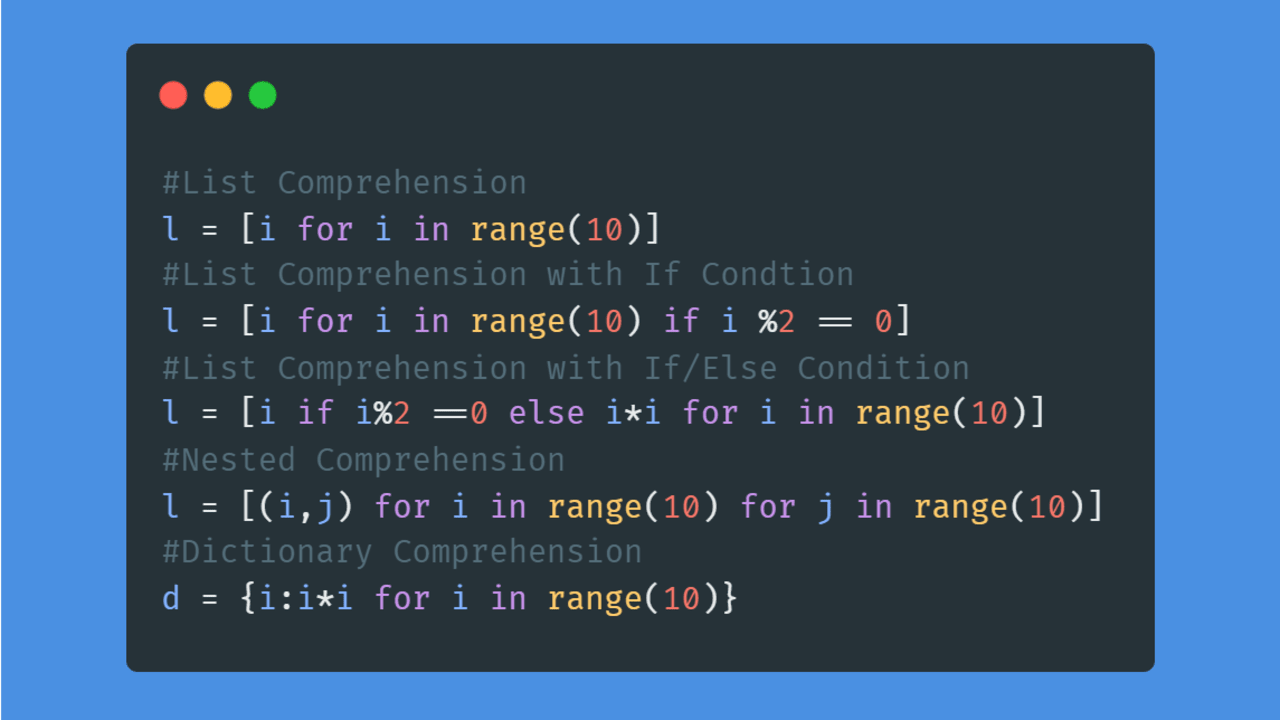
List comprehensions follow a succinct syntax that encapsulates a remarkable amount of functionality within a single line. The foundational structure is as follows:
result = [expression for item in iterable if condition]- Expression: Defines the operation to be performed on each item.
- Item: Represents the variable iterating over the iterable.
- Iterable: Signifies the sequence of elements being traversed.
- Condition (Optional): Allows for the inclusion of items based on a specified criterion.
For instance, consider the elegant creation of a list of squares for numbers 0 to 9:
squares = [x**2 for x in range(10)]
print(squares)
This seemingly simple expression encapsulates a powerful mechanism for creating a list of squares with utmost brevity.
2. Filtering Mastery: Precision with Conditions
List comprehensions excel at introducing conditions, enabling precise filtering during list creation. Delve into the creation of a list containing only even numbers:
even_numbers = [x for x in range(10) if x % 2 == 0]
print(even_numbers)
This showcases the finesse of list comprehensions in elegantly filtering elements to meet specific criteria.
3. Unraveling the depths: nested List Comprehensions
Python's support for nested list comprehensions allows for the creation of complex structures effortlessly. Let's venture into the realm of a 2D matrix:
matrix = [[i * j for j in range(3)] for i in range(3)]
print(matrix)
This concise expression not only generates a 3x3 matrix but also highlights the hierarchical beauty of nested list comprehensions.
4. The art of transformation: mapping and beyond
List comprehensions are a potent tool for mapping and transforming data with elegance. Witness the transformation of a list of names to capitalized versions:
names = ['alice', 'bob', 'charlie']
capitalized_names = [name.capitalize() for name in names]
print(capitalized_names)
This seemingly straightforward operation conceals the power of list comprehensions in transforming data structures effortlessly.
5. Behind the scenes: efficiency and optimizations
Beyond their aesthetic appeal, list comprehensions carry an inherent efficiency. Python's implementation is optimized for performance, making them a preferred choice in many scenarios. Understanding the underlying mechanisms allows you to leverage their efficiency wisely.
6. Harnessing complexity: a powerful database query example
Let's delve into a real-world scenario where list comprehensions showcase their prowess in crafting complex yet concise code. Consider a situation where you have a list of dictionaries representing records from a database, and you want to filter and transform the data dynamically. Using traditional loops and conditional statements can be verbose, but with list comprehensions, we can achieve this task elegantly.
# Sample data representing database records
database_records = [
    {'id': 1, 'name': 'Alice', 'age': 28, 'city': 'New York'},
    {'id': 2, 'name': 'Bob', 'age': 32, 'city': 'San Francisco'},
    {'id': 3, 'name': 'Charlie', 'age': 25, 'city': 'Los Angeles'},
    # ... more records
]

# Define conditions for filtering and transformation
target_age = 30
target_cities = ['New York', 'San Francisco']

# Use list comprehensions for dynamic filtering and transformation
filtered_and_transformed_data = [
    {
        'user_id': record['id'],
        'full_name': f"{record['name']} Smith",
        'location': 'East Coast' if record['city'] in target_cities else 'West Coast'
    }
    for record in database_records
    if record['age'] > target_age
]

# Display the result
print(filtered_and_transformed_data)
In this example, we filter records based on age and transform the data, adding a 'full_name' field and categorizing the location as 'East Coast' or 'West Coast' based on the city. The concise yet expressive nature of list comprehensions allows us to perform these operations in a single line, showcasing the depth of complexity they can handle effectively.
Blog Statistics